Legal IPTV Providers in Canada: The Best 7 Options, Compared
Legal IPTV providers in Canada are the services that hold the rights to distribute the channels they stream. In practice, that means licensed TV distributors such as Bell Fibe TV, TELUS Optik TV and Rogers Xfinity TV, a few independent internet providers, and streaming apps run by the rights holders themselves. IPTV technology itself is legal; the rights behind each channel are what make a service legal or not.
Legal IPTV providers in Canada: the short answer
In Canada, a company that delivers TV channels to subscribers is a broadcasting distribution undertaking, and the Canadian Radio-television and Telecommunications Commission (CRTC) licenses or exempts it. Licensed distributors pay the channels they carry and follow CRTC rules, such as offering a basic package of no more than $25 a month. That is what separates legal IPTV providers from everyone else selling a login.
So the quick test is simple: if a company appears in the CRTC’s records as a distributor, or is the broadcaster that owns the rights, it is a legal IPTV provider for the channels it carries. If it does not, it is not licensed, whatever its website says.
7 licensed IPTV providers in Canada
These seven legal IPTV providers deliver TV over internet protocol under Canadian broadcasting licences. Each one sells TV with its own internet service, so availability depends on your address. For one city in detail, see how Telus Optik TV, Rogers and Novus compare in Vancouver.
| Provider | TV service | Where | Sold with |
|---|---|---|---|
| Bell | Fibe TV | Ontario, Quebec, Atlantic Canada, Manitoba | Bell internet |
| TELUS | Optik TV | B.C., Alberta, eastern Quebec | TELUS internet |
| Rogers | Xfinity TV (formerly Ignite TV) | Rogers cable areas, including the former Shaw network in the West | Rogers internet |
| Vidéotron | Helix | Quebec | Vidéotron internet |
| SaskTel | maxTV | Saskatchewan | SaskTel service |
| TekSavvy | TekSavvy TV | Ontario, Quebec and select regions | TekSavvy internet, 15 Mbps+ |
| VMedia | VMedia TV | Most provinces | VMedia internet |
The list keeps changing. Bell stopped selling new Distributel TV plans in 2025 and new Virgin Plus TV plans in Ontario on January 14, 2026, yet some guides still list them, including WhistleOut’s IPTV guide, which still names Distributel. Always check the provider’s own site.
Legal streaming apps
Not all legal IPTV providers are TV distributors. Broadcasters and rights holders sell their own apps: Bell’s Fibe TV app streams without a Bell box, and Fubo carries live sports it holds Canadian rights to, including Premier League soccer. These apps are legal for the channels their owners have rights to, which is why sports fans often need more than one.
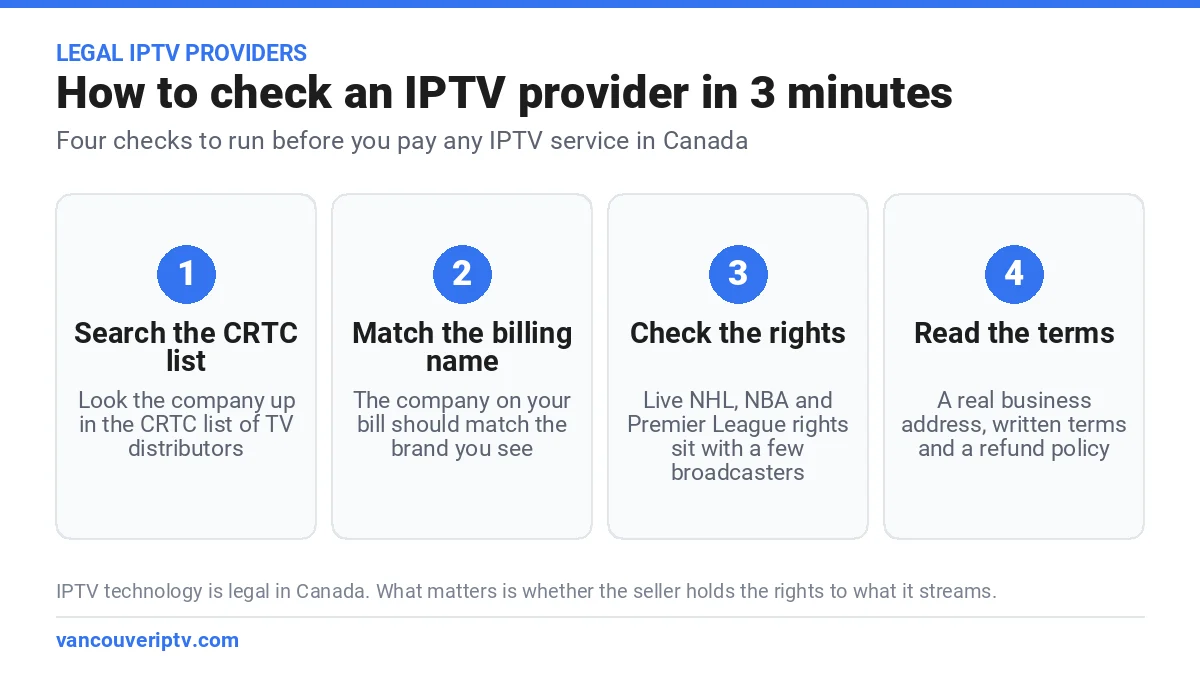
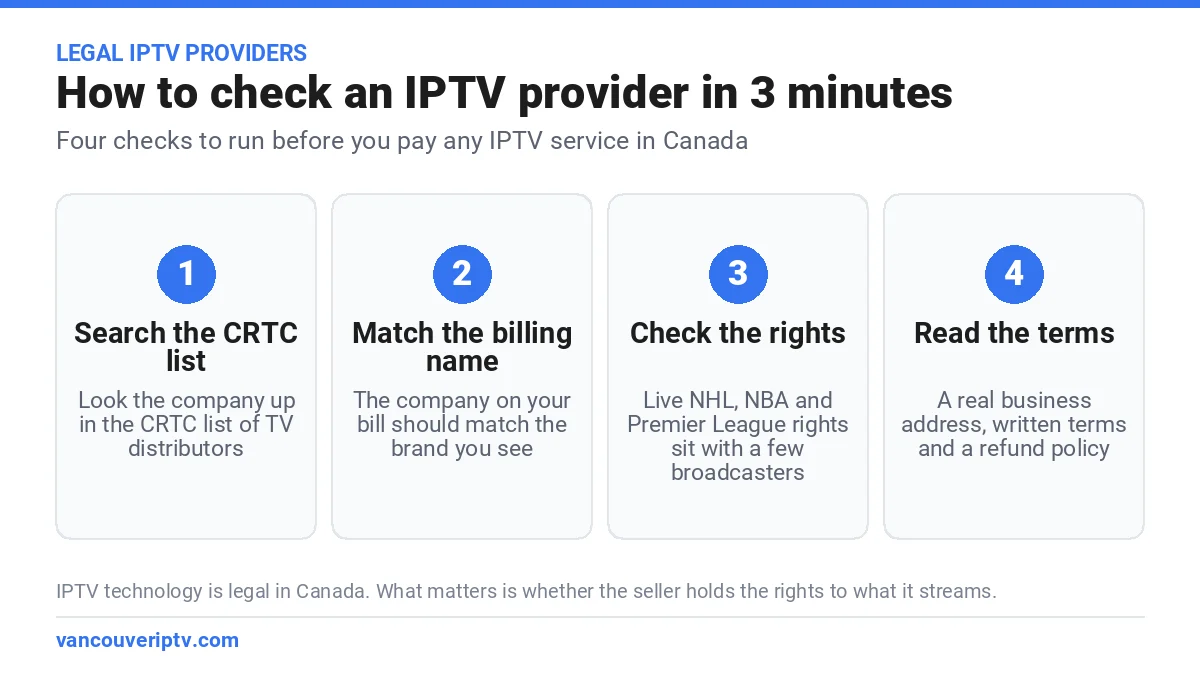
How to check if an IPTV provider is legal in 3 minutes
You do not need a lawyer to check whether a service is one of the legal IPTV providers. Four checks cover almost every case:
- Search the CRTC list. The CRTC publishes a list of broadcasting distribution undertakings as open data. Download it and search for the company name. Licensed distributors are there; resellers of online logins are not.
- Match the billing name. The company that charges your card should be the brand you are buying from, with a Canadian business address you can look up.
- Check who holds the rights. Live NHL, NBA and Premier League rights in Canada sit with a short list of broadcasters, including Rogers, Bell, TVA and Fubo, as the court filings below show. Licensed TV providers carry those games through channels like Sportsnet and TSN. A seller that is neither a broadcaster nor a licensed distributor is not licensed for them.
- Read the written terms. Licensed providers publish contracts, privacy policies and the consumer information the CRTC requires. Missing terms are a warning sign on their own.
If a service fails the first check, it is not a licensed distributor, whatever else it offers. That does not tell you whether it is reliable; it tells you it is not one of the legal IPTV providers on the CRTC’s list.
What the Federal Court blocking orders mean for your streams
So far, the major IPTV cases in Canada have targeted the services and the internet providers that carry them, not individual viewers. The result is a series of court orders that tell ISPs to block unauthorized streams:
| Year | Order | What it did |
|---|---|---|
| 2019 | GoldTV | First nationwide blocking order in Canada. ISPs had 15 days to block an IPTV service selling 4,000 channels from $15 a month. The Federal Court of Appeal upheld it in 2021. |
| 2022 | 2022 FC 775 | First dynamic order: ISPs had to block streaming servers in real time during live NHL games, for the 2021–22 season. |
| 2024 | 2024 FC 1082 | Two-year order covering NHL, NBA and Premier League games, with room to add other live events. Applicants included Rogers, Bell and Fubo. |
Under the 2024 order, internet providers named in the case, including TELUS, SaskTel, TekSavvy and Cogeco, must block or try to block streaming servers flagged as unauthorized during live game windows. For a viewer, that looks like a stream that cuts out mid-game and comes back on a new server, or does not come back at all.
Orders do not last forever: rights holders let the original GoldTV order expire in 2024 and moved on to new targets. The pattern is what matters. Unlicensed services in Canada work under the risk of being blocked, and that risk lands on live sports first. Legal IPTV providers are not the target of these orders; in most cases they are the ones that asked for them.
Legal IPTV providers vs unlicensed services: what changes for you
The difference between legal IPTV providers and unlicensed sellers is not picture quality. It is what stands behind the service when something goes wrong.
| Legal IPTV providers | Unlicensed services | |
|---|---|---|
| Channel rights | Paid to the channels they carry | Not held for most channels |
| Price | Basic package up to $25/month, plus theme packs and equipment | Often one low price for everything |
| Live sports | Carried through licensed channels | Can be blocked during live games under court orders |
| If you have a problem | Complaints can go to the CCTS, Canada’s telecom and TV complaints body | The seller’s own support and refund terms only |
| Contract | Often a two-year term on promotions | Usually prepaid, no contract |
Neither column is right for everyone. Legal IPTV providers cost more and tie you to their internet; unlicensed services cost less and carry more risk. What matters is that you choose knowing which is which.
Is IPTV legal in Canada?
Yes, IPTV as a technology is legal. Bell, TELUS and Rogers, the biggest legal IPTV providers in the country, all deliver TV this way. What can make a service illegal is distributing channels without the rights to them, which is a copyright question, not a technology one. The major court actions in Canada so far have targeted the services and required ISPs to block them.
We are not lawyers, and this is not legal advice. If your situation depends on the answer, ask a Canadian lawyer who works in copyright.
Where does an online IPTV subscription like ours fit?
Plainly: Vancouver IPTV is an independent online reseller, not one of the legal IPTV providers listed as distributors in the CRTC’s records. We do not host or stream content ourselves; channels come from third-party providers, and viewers are responsible for having the right to watch content where they live. We would rather you know that before you buy than after. Our refund policy and DMCA notice are public for the same reason.
If you want to compare every option, including the legal IPTV providers above, read our guide to IPTV providers in Canada, which sets all four types side by side with yearly costs. To see who leads on subscriber numbers, see the biggest IPTV provider in Canada.
FAQ: legal IPTV providers
Which IPTV legal providers work across Canada?
No single licensed IPTV provider covers the whole country. Bell, TELUS, Rogers, Vidéotron and SaskTel each cover their own regions, and TekSavvy and VMedia sell TV only to their own internet customers. Streaming apps such as Fubo work nationwide.
How do I know if an IPTV provider is licensed?
Search the company in the CRTC’s open-data list of broadcasting distribution undertakings, and check that the name on your bill matches the brand. Licensed providers also publish full terms and CRTC information on their sites.
Is Fubo legal in Canada?
Yes. Fubo holds Canadian rights to the sports it streams, including Premier League soccer, and was one of the rights holders that asked the Federal Court for the 2024 blocking order against unauthorized streams.
Can my internet provider block an IPTV service?
Yes, when a court orders it. Since 2019, Federal Court orders have required Canadian ISPs to block specific IPTV services, and since 2022, to block streaming servers in real time during live games.
Does a VPN make an IPTV service legal?
No. A VPN changes how your connection is routed, not who holds the rights to a channel. Whether a service is legal depends on its licences, not on how you connect to it.
Vancouver IPTV is an independent Canadian reseller and does not host or stream copyrighted content; all content is supplied by third-party providers, and channel lineups are subject to change. Bell, Fibe, TELUS, Optik TV, Rogers, Xfinity, Vidéotron, Helix, SaskTel, maxTV, TekSavvy, VMedia, Distributel, Virgin Plus, Fubo, TVA, Cogeco and channel names belong to their respective owners. Users are responsible for ensuring they have the right to view content in their jurisdiction. See our DMCA notice.